Real Home Based Business,
Leverage, Residual, Royalty and additional income,Care your retirement,
Inherited to your kids,
Enjoy and excitement playing free online games and Bid online on penny auctions , win it at 77% less Market retail price,
Global customer based 20th years running the business
Dream High , Earn Big
Love card games? Play the NEW CARD KING game at TripleClicks! Play FREE daily for great prizes, badges, and a share of today's Zackpot! Details at: https://www.tripleclicks.com/17035695/games
Christmas is an annual festival commemorating the birth of Jesus Christ, observed primarily on December 25as a religious and cultural celebration among billions of people around the world. A feast central to the Christianliturgical year, it is preceded by the season of Advent or the Nativity Fast and initiates the season of Christmastide, Christmastide or Christmastimeor Christmas season) is a season of theliturgical yearin mostChristianchurches. In some Christian denominations, Christmastide is identical toTwelvetide, a similar concept.
Christmas Day is a public holiday in many of the world's nations,is celebrated religiously by a majority of Christians, as well as culturally by many non-Christians, and forms an integral part of the holiday season centered around it.
Christmas Eve is the evening or entire day before Christmas Day, the festival commemorating the birth of Jesus. Since tradition holds that Jesus was born at night (based in Luke 2:6-8), Midnight Mass is celebrated on Christmas Eve, traditionally at midnight, in commemoration of his birth.
We celebrate Christmas Eve because Jesus is traditionally thought to have been born at midnight, and we celebrate New Year's Eve because midnight is when the year changes
Christmas, Christian festival celebrating the birth of Jesus. The English term Christmas (“mass on Christ's day”) is of fairly recent origin. The earlier term Yule may have derived from the Germanic jōl or the Anglo-Saxon geōl, which referred to the feast of the winter solstice.
How was the Christmas started?
The first recorded date of Christmasbeing celebrated on December 25th was in 336, during the time of the Roman Emperor Constantine (he was the first Christian Roman Emperor). ... However, there are many different traditions and theories as to whyChristmasis celebrated on December 25th.
Christmas is celebrated to remember the birth of of Jesus Christ, who Christians believe is the Son of God.
The name 'Christmas' comes from the Mass of Christ (or Jesus). A Mass service (which is sometimes called Communion or Eucharist) is where Christians remember that Jesus died for us and then came back to life. The 'Christ-Mass' service was the only one that was allowed to take place after sunset (and before sunrise the next day), so people had it at Midnight! So we get the name Christ-Mass, shortened to Christmas.
The Date of Christmas
No one knows the real birthday of Jesus!
No date is given in the Bible, so why do we celebrate it on the 25th December?
The early Christians certainly had many arguments as to when it should be celebrated! Also, the birth of Jesus probably didn't happen in the year 1 but slightly earlier, somewhere between 2 BCE/BC and 7 BCE/BC, possibly in 4 BCE/BC (there isn't a 0 - the years go from 1 BC/BCE to 1!).
The first recorded date of Christmas being celebrated on December 25th was in 336, during the time of the Roman Emperor Constantine (he was the first Christian Roman Emperor). But it was not an official Roman state festival at this time.
However, there are many different traditions and theories as to why Christmas is celebrated on December 25th.
A very early Christian tradition said that the day when Mary was told that she would have a very special baby, Jesus (called the Annunciation) was on March 25th - and it's still celebrated today on the 25th March. Nine months after the 25th March is the 25th December! March 25th was also the day some early Christians thought the world had been made, and also the day that Jesus died on when he was an adult. The date of March 25th was chosen because people had calculated that was the day on which Jesus died as an adult (the 14th of Nisan in the Jewish calendar) and they thought that Jesus was born and had died on the same day of the year.
Some people also think that December 25th might have also been chosen because the Winter Solstice and the ancient pagan Roman midwinter festivals called 'Saturnalia' and 'Dies Natalis Solis Invicti' took place in December around this date - so it was a time when people already celebrated things.
The Winter Solstice is the day where there is the shortest time between the sun rising and the sun setting.
It happens on December 21st or 22nd. To pagans this meant that the winter was over and spring was coming and they had a festival to celebrate it and worshipped the sun for winning over the darkness of winter. In Scandinavia, and some other parts of northern Europe, the Winter Solstice is known as Yule and is where we get Yule Logs from. In Eastern Europe the mid-winter festival is called Koleda.
The Roman Festival of Saturnalia took place between December 17th and 23rd and honoured the Roman god Saturn. Dies Natalis Solis Invicti means 'birthday of the unconquered sun' and was held on December 25th (when the Romans thought the Winter Solstice took place) and was the 'birthday' of the Pagan Sun god Mithra. In the pagan religion of Mithraism, the holy day was Sunday and is where get that word from!
The Roman emperor Aurelian created 'Sol Invictus' in 274. But there are records of early Christians connecting 14th Nisan to 25th March and so the 25th December go back to around 200!
The Jewish festival of Lights, Hanukkah starts on the 25th of Kislev (the month in the Jewish calendar that occurs at about the same time as December). Hanukkah celebrates when the Jewish people were able to re-dedicate and worship in their Temple, in Jerusalem, again following many years of not being allowed to practice their religion.
Jesus was a Jew, so this could be another reason that helped the early Church choose December the 25th for the date of Christmas!
Christmas had also been celebrated by the early Church on January 6th, when they also celebrated the Epiphany (which means the revelation that Jesus was God's son) and the Baptism of Jesus. Now Epiphany mainly celebrates the visit of the Wise Men to the baby Jesus, but back then it celebrated both things! Jesus's Baptism was originally seen as more important than his birth, as this was when he started his ministry. But soon people wanted a separate day to celebrate his birth.
Most of the world uses the 'Gregorian Calendar' implemented by Pope Gregory XIII in 1582. Before that the 'Roman' or Julian Calendar was used (named after Julius Caesar). The Gregorian calendar is more accurate that the Roman calendar which had too many days in a year! When the switch was made 10 days were lost, so that the day that followed the 4th October 1582 was 15th October 1582. In the UK the change of calendars was made in 1752. The day after 2nd September 1752 was 14th September 1752.
Many Orthodox and Coptic Churches still use the Julian Calendar and so celebrate Christmas on the 7th January (which is when December 25th would have been on the Julian calendar). And the Armenian Apostolic Church celebrates it on the 6th January! In some part of the UK, January 6th is still called 'Old Christmas' as this would have been the day that Christmas would have celebrated on, if the calendar hadn't been changed. Some people didn't want to use the new calendar as they thought it 'cheated' them out of 11 days!
Christians believe that Jesus is the light of the world, so the early Christians thought that this was the right time to celebrate the birth of Jesus. They also took over some of the customs from the Winter Solstice and gave them Christian meanings, like Holly, Mistletoe and even Christmas Carols!
St Augustine of Canterbury was the person who probably started the widespread celebration of Christmas in large parts of England by introducing Christianity to the regions run by the Anglo-Saxons in the 6th century (other Celtic parts of Britain were already Christian but there aren't many documents about if or how they celebrated the birth of Jesus). St Augustine of Canterbury was sent by Pope Gregory the Great in Rome and that church used the Roman Calendar, so western countries celebrate Christmas on the 25th December. Then people from Britain and Western Europe took Christmas on the 25th December all over the world!
There's a strong and practical reason why Jesus might not have been born in the winter, but in the spring or the autumn! It can get very cold in the winter and it's unlikely that the shepherds would have been keeping sheep out on the hills (as those hills can get quite a lot of snow sometimes!).
During the spring (in March or April) there's a Jewish festival called 'Passover'. This festival remembers when the Jews had escaped from slavery in Egypt about 1500 years before Jesus was born. Lots of lambs would have been needed during the Passover Festival, to be sacrificed in the Temple in Jerusalem. Jews from all over the Roman Empire traveled to Jerusalem for the Passover Festival, so it would have been a good time for the Romans to take a census. Mary and Joseph went to Bethlehem for the census (Bethlehem is about six miles from Jerusalem).
In the autumn (in September or October) there's the Jewish festival of 'Sukkot' or 'The Feast of Tabernacles'. It's the festival that's mentioned the most times in the Bible! It is when Jewish people remember that they depended on God for all they had after they had escaped from Egypt and spent 40 years in the desert. It also celebrates the end of the harvest. During the festival, Jews live outside in temporary shelters (the word 'tabernacle' come from a latin word meaning 'booth' or 'hut').
Many people who have studied the Bible, think that Sukkot would be a likely time for the birth of Jesus as it might fit with the description of there being 'no room in the inn'. It also would have been a good time to take the Roman Census as many Jews went to Jerusalem for the festival and they would have brought their own tents/shelters with them! (It wouldn't have been practical for Joseph and Mary to carry their own shelter as Mary was pregnant.)
The possibilities for the Star of Bethlehem seems to point either spring or autumn.
The year that Jesus was born isn't known. The calendar system we have now was created in the 6th Century by a monk called Dionysius Exiguus. He was actually trying to create a better system for working out when Easter should be celebrated, based on a new calendar with the birth of Jesus being in the year 1. However, he made a mistake in his maths and so got the possible year of Jesus's birth wrong!
Most scholars now think that Jesus was born between 2 BCE/BC and 7 BCE/BC, possibly in 4 BCE/BC. Before Dionysius's new calendars, years were normally dated from the reigns of Roman Emperors. The new calendar became more widely used from the 8th Century when the 'Venerable Bede of Northumbria' used it in his 'new' history book! There is no year '0'. Bede started dating things before the year 1 and used 1 BCE/BC as the first year before 1. At that time in Europe, the number 0 didn't exist in maths - it only arrived in Europe in the 11th to 13th centuries!
So whenever you celebrate Christmas, remember that you're celebrating a real event that happened about 2000 years ago, that God sent his Son into the world as a Christmas present for everyone!
As well as Christmas and the solstice, there are some other festivals that are held in late December. Hanukkah is celebrated by Jews; and the festival of Kwanzaa is celebrated by some Africans and African Americans takes place from December 26th to January 1st.
Christmas or Xmas?
Christmas is also sometimes known as Xmas. Some people don't think it's correct to call Christmas 'Xmas' as that takes the 'Christ' (Jesus) out of Christmas. (As Christmas comes from Christ-Mass, the Church service that celebrated the birth of Jesus.)
But that is not quite right! In the Greek language and alphabet, the letter that looks like an X is the Greek letter chi / Χ (pronounced 'kye' - it rhymes with 'eye') which is the first letter of the Greek word for Christ, Christos.
The early church used the first two letters of Christos in the Greek alphabet 'chi' and 'rho' to create a monogram (symbol) to represent the name of Jesus. This looks like an X with a small p on the top: ☧
The symbol of a fish is sometimes used by Christians (you might see a fish sticker on a car or someone wearing a little fish badge). This comes from the time when the first Christians had to meet in secret, as the Romans wanted to kill them (before Emperor Constantine became a Christian). Jesus had said that he wanted to make his followers 'Fishers of Men', so people started to use that symbol.
When two Christians met, one person drew half a basic fish shape (often using their foot in the dust on the ground) and the other person drew the other half of the fish. The Greek word for fish is 'Ikthus' or 'Ichthys'. There are five Greek letters in the word. It can also make up a sentence of Christian beliefs 'Ie-sous Christos Theou Huios So-te-r' which in English means "Jesus Christ, Son of God, Saviour". The second letter of these five letter is X or Christos!
So Xmas can also mean Christmas; but it should also be pronounced 'Christmas' rather than 'ex-mas'!
Traditions of Christmas Bells
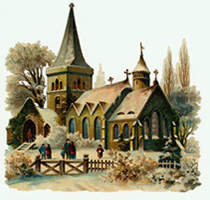
Bells, especially Church Bells, have traditionally been associated with Christmas for a long time. In the Anglican and Catholic churches, the church day starts at sunset, so any service after that is the first service of the day. So a service on Christmas Eve after sunset is traditionally the first service of Christmas day! In churches that have a Bell or Bells, They are often rung to signal the start of this service.
In some churches in the UK, it is traditional that the largest bell in the church is rung four times in the hour before midnight and then at midnight all the bells are rung in celebration.
In the Catholic Church, Christmas and Easter are the only times that Mass is allowed to be held at Midnight. It's traditional that at both midnight Masses, the church and altar bells too in many cases are rung while the Priest says the "Gloria" (Gloria in excelsis Deo).
Having a Mass at Midnight at Christmas dates back to the early church, when it was believed that Jesus was born at midnight, although there has never been any proof of this! A lot of Churches have midnight services on Christmas Eve, although not every church will have a mass or communion as part of the service.
In many Catholic countries such as France, Spain and Italy, the midnight mass service is very important and everyone tries to go to a service.
In Victorian times, it was very fashionable to go carol singing with small handbells to play the tune of the carol. Sometimes there would only be the bells and no singing! Handbell ringing is still popular today.
Perhaps the most famous bells at Christmas now are the ones in the song 'Jingle Bells'. However, the song was first called "One Horse Open Sleigh" and was originally published, in the USA, in September 1857 as a Thanksgiving song and NOT a Christmas one! But it soon became associated with Christmas because of the 'snowy' lyrics and many choirs were singing it at Christmas in the 1860s and 1870s. It was first recorded in 1889. Often only the first verse (and chorus) are now sung. The other verses are about driving the 'one horse open sleigh' rather fast and crashing it!
Jingle Bells was also the first song to be broadcast from space in December 1965 when the astronauts Tom Stafford and Wally Schirra said they had spotted a sleigh in space! They then took out a harmonica and sleigh bells which they had smuggled onto the Gemini 6 space craft and played and sang the song to mission control.
Jingle Bells was written by James Lord Pierpont (1822–1893) and the original version had some slightly different words and a slightly different tune for the chorus than are used today. There is some debate as to where it was written. Some people claim it was written in 1850 Medford, Massachusetts; while other people claim it was written nearer 1875 when James Lord Pierpoint lived in Savannah, Georgia
Merry Christmas and Happy Christmas
We wish people a 'Happy Birthday', and if you're in the USA in November and December you might say 'Happy Holidays', so why do we say 'Merry Christmas' more often than 'Happy Christmas'?!
Saying 'Merry Christmas' rather than 'Happy Christmas' seems to go back several hundred years. It's first recorded in 1534 when John Fisher (an English Catholic Bishop in the 1500s) wrote it in a Christmas letter to Thomas Cromwell: "And this our Lord God send you a mery Christmas, and a comfortable, to your heart’s desire."
There's also the carol "God Rest You Merry, Gentlemen" which dates back to the 16th century in England. It comes from the West Country in England and it was first published in the form we know it today in 1760.
In the English language of the time, the phrase 'Rest You Merry' didn't mean simply to be happy; 'rest' meant "to keep, cause to continue to remain" and 'merry' could mean "pleasant, bountiful, prosperous". So you could write the first line as "[May] God keep you and continue to make you successful and prosperous, Gentlemen" but that would be hard to sing!
The comma in the phrase should be AFTER the 'merry' not BEFORE it! But it's often put after the merry which changes the meaning to make 'merry Gentleman' and so a 'Merry Christmas'!
The term 'Merry Christmas' might well have been made very popular in 1843 from two different sources.
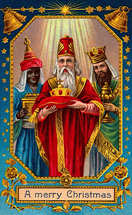
The first Christmas Card, sent in 1843 by Sir Henry Cole, had this wording on it: "A Merry Christmas and a Happy New Year to You".
A Christmas Carol by Charles Dickens was also published in 1843 and the phrase 'Merry Christmas' appears 21 times in the book! Charles Dickens also quoted "God Rest You Merry, Gentlemen" in A Christmas Carol, but changed it to: "God bless you, merry gentleman! May nothing you dismay!" moving the comma to before the merry!
The Carol "We Wish You a Merry Christmas [and a Happy New Year]" is another old carol from the 'West Country' (South West England) but was only first published in 1935 and this probably confirmed the use of 'Merry Christmas' over 'Happy Christmas'.
The Man Behind the Story of Father Christmas/Santa Claus
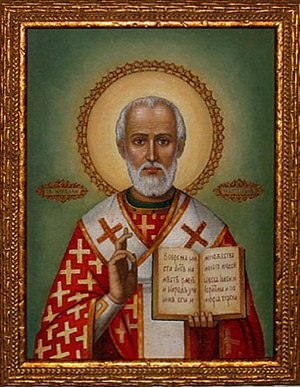
St. Nicholas was a Bishop who lived in the fourth century in a place called Myra in Asia Minor (now called Turkey). He was a very rich man because his parents died when he was young and left him a lot of money. He was also a very kind man and had a reputation for helping the poor and giving secret gifts to people who needed it. There are several legends about St. Nicholas, although we don't know if any of them are true!
The most famous story about St. Nicholas tells how the custom of hanging up stockings to put presents in first started! It goes like this:
There was a poor man who had three daughters. The man was so poor that he did not have enough money for a dowry, so his daughters couldn't get married. (A dowry is a sum of money paid to the bridegroom by the brides parents on the wedding day. This still happens in some countries, even today.) One night, Nicholas secretly dropped a bag of gold down the chimney and into the house (This meant that the oldest daughter was then able to be married.). The bag fell into a stocking that had been hung by the fire to dry! This was repeated later with the second daughter. Finally, determined to discover the person who had given him the money, the father secretly hid by the fire every evening until he caught Nicholas dropping in a bag of gold. Nicholas begged the man to not tell anyone what he had done, because he did not want to bring attention to himself. But soon the news got out and when anyone received a secret gift, it was thought that maybe it was from Nicholas.
Because of his kindness Nicholas was made a Saint. St. Nicholas is not only the saint of children but also of sailors! One story tells of him helping some sailors that were caught in a dreadful storm off the coast of Turkey. The storm was raging around them and all the men were terrified that their ship would sink beneath the giant waves. They prayed to St. Nicholas to help them. Suddenly, he was standing on the deck before them. He ordered the sea to be calm, the storm died away, and they were able to sail their ship safely to port.
St. Nicholas was exiled from Myra and later put in prison during the persecution by the Emperor Diocletian. No one is really knows when he died, but it was on 6th December in either 345 or 352. In 1087, his bones were stolen from Turkey by some Italian merchant sailors. The bones are now kept in the Church named after him in the Italian port of Bari. On St. Nicholas feast day (6th December), the sailors of Bari still carry his statue from the Cathedral out to sea, so that he can bless the waters and so give them safe voyages throughout the year.
in 1066, before he set sail to England, William the Conqueror prayed to St. Nicholas asking that his conquest would go well.
In the 16th Century in northern Europe, after the reformation, the stories and traditions about St. Nicholas became unpopular.
But someone had to deliver presents to children at Christmas, so in the UK, particularly in England, he became 'Father Christmas' or 'Old Man Christmas', an old character from stories plays during the middle ages in the UK and parts of northern Europe. In France, he was then known as 'Père Nöel'.
In some countries including parts of Austria and Germany, present giver became the 'Christkind' a golden-haired baby, with wings, who symbolizes the new born baby Jesus.
In the early USA his name was 'Kris Kringle' (from the Christkind). Later, Dutch settlers in the USA took the old stories of St. Nicholas with them and Kris Kringle and St Nicholas became 'Sinterklaas' or as we now say 'Santa Claus'!
Many countries, especially ones in Europe, celebrate St. Nicholas' Day on 6th December. In The Netherlands and some other European Countries, children leave clogs or shoes out on the 5th December (St. Nicholas Eve) to be filled with presents. They also believe that if they leave some hay and carrots in their shoes for Sinterklaas's horse, they will be left some sweets.
St. Nicholas became popular again in the Victorian era when writers, poets and artists rediscovered the old stories.
In 1823 the famous poem 'A Visit from St. Nicholas' or 'T'was the Night before Christmas', was published. Dr Clement Clarke Moore later claimed that he had written it for his children. (Some scholars now believe that it was actually written by Henry Livingston, Jr., who was a distant relative of Dr Moore's wife.) The poem describes St. Nicholas with eight reindeer and gives them their names. They became really well known in the song 'Rudolph the Red nosed Reindeer', written in 1949. Do you know all eight names? Click on Rudolph's nose to find out!
Click my nose to find out more about my friends!
Did you know that Rudolph and Santa's other reindeers might well be all girls!? Only female reindeer keep their antlers throughout winter. By Christmas time most males have discarded their antlers and are saving their energy ready to grow a new pair in the spring.
The UK Father Christmas and the American Santa Claus became more and more alike over the years and are now one and the same.
Some people say that Santa lives at the North Pole. In Finland, they say that he lives in the north part of their country called Lapland.
But everyone agrees that he travels through the sky on a sledge that is pulled by reindeer, that he comes into houses down the chimney at night and places presents for the children in socks or bags by their beds, in front of the family Christmas tree, or by the fire place.
Most children receive their presents on Christmas Eve night or early Christmas morning, but in some countries they get their presents on St. Nicholas' Eve, December 5th.
St. Nicholas putting the bag of gold into a stocking is probably where the custom of having a tangerine or satsuma at the bottom of your Christmas stocking came from. If people couldn't afford gold, some golden fruit was a good replacement - and until the last 50 years these were quite unusual fruits and so still special!
The biggest Christmas stocking was 51m 35cm (168ft 5.65in) long and 21m 63cm (70ft 11.57in) wide (from the heel to the toe). It was made the volunteer emergency services organisation Pubblica Assistenza Carrara e Sezioni (Italy) in Carrara, Tuscany, Italy, on 5th January 2011. Just think how many presents you could fit in that!
Santa Claus and Coca-Cola
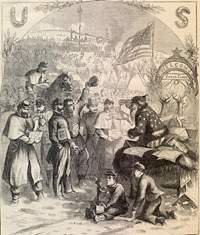
St. Nicholas in Harper's Weekly: January 1863
There's a Christmas Urban Legend that says that Santa's red suit was designed by Coca-Cola and that they might even 'own' Santa!
This is definitely NOT TRUE!
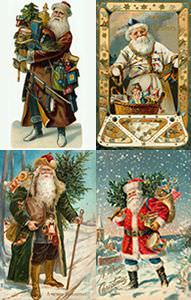
Long before coke had been invented, St Nicholas had worn his Bishop's red robes. During Victorian times and before that, he wore a range of colors (red, green, blue and brown fur) but red was always his favorite!
In January 1863, the magazine Harper's Weekly published the first illustration of St Nicholas/St Nick by Thomas Nast. In this he was wearing a 'Stars and Stripes' outfit! Over the next 20 years Thomas Nast continued to draw Santa every Christmas and his works were very popular indeed (he must have been very good friends with Santa to get such good access!).
This is when Santa really started to develop his big tummy and the style of red and white outfit he wears today. Nast designed Santa's look on some historical information about Santa and the poem 'A Visit from St. Nicholas'.
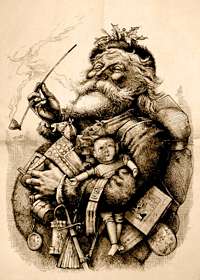
St. Nicholas in Harper's Weekly: January 1881
On January 1st 1881, Harper's Weekly published Nast's most famous image of Santa, complete with a big red belly, an arm full of toys and smoking a pipe!
This image of Santa became very popular, with more artists drawing Santa in his red and white costume from 1900 to 1930.
Santa was first used in Coke adverts in the 1920s, with Santa looking like the drawings of Thomas Nast. In 1931, the classic 'Coke Santa' was drawn by artist Haddon Sundblom. He took the idea of Nast's Santa but made him even more larger than life and jolly, replaced the pipe with a glass of Coke and created the famous Coke holding Santa!
Coca-Cola also agree that the red suit was made popular by Thomas Nast not them!
Coke has continued to use Santa in their adverts since the 1930s. In 1995 they also introduced the 'Coca-Cola Christmas truck' in the 'Holidays are coming' TV adverts. The red truck, covered with lights and with the classic 'Coke Santa' on its sides is now a famous part of recent Christmas history.
The History of Christmas Trees
The evergreen fir tree has traditionally been used to celebrate winter festivals (pagan and Christian) for thousands of years. Pagans used branches of it to decorate their homes during the winter solstice, as it made them think of the spring to come. The Romans used Fir Trees to decorate their temples at the festival of Saturnalia. Christians use it as a sign of everlasting life with God.
Nobody is really sure when Fir trees were first used as Christmas trees. It probably began about 1000 years ago in Northern Europe. Many early Christmas Trees seem to have been hung upside down from the ceiling using chains (hung from chandeliers/lighting hooks).
Other early Christmas Trees, across many parts of northern Europe, were cherry or hawthorn plants (or a branch of the plant) that were put into pots and brought inside so they would hopefully flower at Christmas time. If you couldn't afford a real plant, people made pyramids of woods and they were decorated to look like a tree with paper, apples and candles. Sometimes they were carried around from house to house, rather than being displayed in a home.
It's possible that the wooden pyramid trees were meant to be like Paradise Trees. These were used in medieval German Mystery or Miracle Plays that were acted out in front of Churches on Christmas Eve. In early church calendars of saints, 24th December was Adam and Eve's day. The Paradise Tree represented the Garden of Eden. It was often paraded around the town before the play started, as a way of advertising the play. The plays told Bible stories to people who could not read.
The first documented use of a tree at Christmas and New Year celebrations is argued between the cities of Tallinn in Estonia and Riga in Latvia! Both claim that they had the first trees; Tallinn in 1441 and Riga in 1510. Both trees were put up by the 'Brotherhood of Blackheads' which was an association of local unmarried merchants, ship owners, and foreigners in Livonia (what is now Estonia and Latvia).
Little is known about either tree apart from that they were put in the town square, were danced around by the Brotherhood of Blackheads and were then set on fire. This is like the custom of the Yule Log. The word used for the 'tree' could also mean a mast or pole, tree might have been like a 'Paradise Tree' or a tree-shaped wooden candelabra rather than a 'real' tree.
In the town square of Riga, the capital of Latvia, there is a plaque which is engraved with "The First New Year's Tree in Riga in 1510", in eight languages. You can find out more about the Riga Tree from this website: www.firstchristmastree.com
A picture from Germany in 1521 which shows a tree being paraded through the streets with a man riding a horse behind it. The man is dressed a bishop, possibly representing St. Nicholas.
In 1584, the historian Balthasar Russow wrote about a tradition, in Riga, of a decorated fir tree in the market square where the young men “went with a flock of maidens and women, first sang and danced there and then set the tree aflame”. There's a record of a small tree in Breman, Germany from 1570. It is described as a tree decorated with "apples, nuts, dates, pretzels and paper flowers". It was displayed in a 'guild-house' (the meeting place for a society of business men in the city).
The first person to bring a Christmas Tree into a house, in the way we know it today, may have been the 16th century German preacher Martin Luther. A story is told that, one night before Christmas, he was walking through the forest and looked up to see the stars shining through the tree branches. It was so beautiful, that he went home and told his children that it reminded him of Jesus, who left the stars of heaven to come to earth at Christmas. Some people say this is the same tree as the 'Riga' tree, but it isn't! The Riga tree originally took place a few decades earlier.
The custom of having Christmas trees could well have travelled along the Baltic sea, from Latvia to Germany. In the 1400s and 1500s, the countries which are now Germany and Latvia were them part of two larger empires which were neighbors.
Another story says that St. Boniface of Crediton (a village in Devon, UK) left England and traveled to Germany to preach to the pagan German tribes and convert them to Christianity. He is said to have come across a group of pagans about to sacrifice a young boy while worshipping an oak tree. In anger, and to stop the sacrifice, St. Boniface is said to have cut down the oak tree and, to his amazement, a young fir tree sprang up from the roots of the oak tree. St. Boniface took this as a sign of the Christian faith and his followers decorated the tree with candles so that St. Boniface could preach to the pagans at night.
There is another legend, from Germany, about how the Christmas Tree came into being, it goes:
Once on a cold Christmas Eve night, a forester and his family were in their cottage gathered round the fire to keep warm. Suddenly there was a knock on the door. When the forester opened the door, he found a poor little boy standing on the door step, lost and alone. The forester welcomed him into his house and the family fed and washed him and put him to bed in the youngest sons own bed (he had to share with his brother that night!). The next morning, Christmas Morning, the family were woken up by a choir of angels, and the poor little boy had turned into Jesus, the Christ Child. The Christ Child went into the front garden of the cottage and broke a branch off a Fir tree and gave it to the family as a present to say thank you for looking after him. So ever since them, people have remembered that night by bringing a Christmas Tree into their homes!
In Germany, the first Christmas Trees were decorated with edible things, such as gingerbread and gold covered apples. Then glass makers made special small ornaments similar to some of the decorations used today. In 1605 an unknown German wrote: "At Christmas they set up fir trees in the parlours of Strasbourg and hang thereon roses cut out of many-colored paper, apples, wafers, gold foil, sweets, etc."
At first, a figure of the Baby Jesus was put on the top of the tree. Over time it changed to an angel/fairy that told the shepherds about Jesus, or a star like the Wise Men saw.
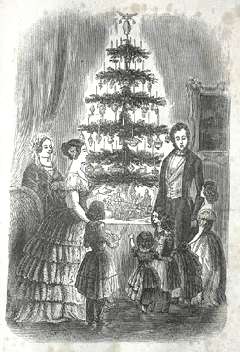
The first Christmas Trees came to Britain sometime in the 1830s. They became very popular in 1841, when Prince Albert (Queen Victoria's German husband) had a Christmas Tree set up in Windsor Castle. In 1848, drawing of "The Queen's Christmas tree at Windsor Castle" was published in the Illustrated London News. The drawing was republished in Godey's Lady's Book, Philadelphia in December 1850 (but they removed the Queen's crown and Prince Albert's moustache to make it look 'American'!).
The publication of the drawing helped Christmas Trees become popular in the UK and USA.
In Victorian times, the tree would have been decorated with candles to represent stars. In many parts of Europe, candles are still used to decorate Christmas trees.
Tinsel and The Legend of the Christmas Spider
Tinsel was also created in Germany, were it was originally made from thin strips of beaten silver. But when plastic/man made tinsel was invented, it became very popular as it was much cheaper than real silver and also lighter to go on the tree!
There are also folk stories about how tinsel was created - by The Christmas Spider!
These tales seem to have started in Eastern Germany, Poland or Ukraine but are also told in parts of Finland and Scandinavia. The stories are now also popular in other countries such as the USA; although I live in the UK and most people in my country have never heard of the story/legend!
All the versions of the story involve a poor family who can't afford to decorate a Tree for Christmas (in some versions the tree grew from a pine cone in their house, in others the family have bought a tree into the house). When the children go to sleep on Christmas Eve a spider covers the tree in cobwebs. Then on Christmas morning the cobwebs are magically turned into silver and gold strands which decorate the tree!
Some versions of the story say that it's the light of the sun which changed the cobwebs into silver and gold but other versions say it's St Nicholas / Santa Claus / Father Christmas / das Christkind which made the magic happen.
In parts of Germany, Poland, and Ukraine it's meant to be good luck to find a spider or a spider's web on your Christmas Tree. Spider's web Christmas Tree decorations are also popular in Ukraine. They're called 'pavuchky' (which means 'little spider') and the decorations are normally made of paper and silver wire. You might even put an artificial spider's web on your tree!
Christmas Tree Lights
There are a few different claims as to who invented popularised the first strings of 'electric' Christmas Tree lights. In 1880, the famous inventor Thomas Edison put some of his new electric light bulbs around his office. And in 1882 Edward Johnson, who was a colleague of Edison, hand-strung 80 red, white and blue bulbs together and put them on his tree in his New York apartment (there were two additional strings of 28 lights mounted from the ceiling!).
In 1890 the Edison company published a brochure offering lighting services for Christmas. In 1900 another Edison advert offered bulbs which you could rent, along with their lighting system, for use over Christmas! There are records in a diary from 1891 where settlers in Montana used electric lights on a tree. However, most people couldn't easily use electric tree lights at this time as electricity wasn't widely installed in homes. But rich people liked to show off with lights installed just for Christmas, this would have cost about $300 per tree then, more than $2000 money today!
Electric tree lights first because widely known in the USA in 1895 when President Grover Cleveland has the tree in the White House decorated with lights as his young daughters liked them! The tradition of the National Christmas Tree on the White House lawn started in 1923 with President Calvin Coolidge.
The first commercially available electric string of lights, which more people could afford, were advertised in 1903 when a string of 24 lights cost $12 or you could rent lights from $1.50. This was still quite expensive, but much cheaper than $300.
Another claim to the first widespread sale of strings of lights comes from Ralph Morris, an American telephonist. In 1908, he used telephone wire to string together small bulbs from a telephone exchange and decorated a table top tree with them. Leavitt Morris, the son of Ralph, wrote an article in 1952 for the Christian Science Monitor, about his father inventing Christmas Tree lights, as he was un-aware of the Edison lights.
In 1885 a hospital in Chicago burned down because of candles on a Christmas Tree. In 1908 insurance companies in the USA tried to get a law made that would ban candles from being used on Christmas Trees because of the many fires they had caused. However, people still used candles to light Christmas Trees and there were more fires.
In 1917, a fire from Christmas Tree candles in New York, gave a teenager called Albert Sadacca an idea. His family came from Spain and made novelty wicker bird cages that lit up. Albert thought of using the lights in long strings and also suggested painting the bulbs bright colors like red and green. In the following years, he and his brothers formed the NOMA Electric Company, which became a very famous name in Christmas lights (I've actually got some old NOMA lights in my Christmas decorations!)
The most lights lit at the same time on a Christmas tree is 194,672 and was done by Kiwanis Malmedy / Haute Fagnes Belgium in Malmedy, Belgium, on 10 December 2010!
Many towns and villages have their own Christmas Trees. One of the most famous is the tree in Trafalgar Square in London, England, which is given to the UK by Norway every year as a 'thank you' present for the help the UK gave Norway in World War II. The White House in the USA has had a big tree on the front lawn since the 1920s.
The record for the most Christmas trees chopped down in two minutes is 27 and belongs to Erin Lavoie from the USA. She set the record on 19th December 2008 on the set of Guinness World Records: Die GroBten Weltrekorde in Germany.
Artificial Christmas Trees really started becoming popular in the early 20th century. In the Edwardian period Christmas Trees made from colored ostrich feathers were popular at 'fashionable' parties. Around 1900 there was even a short fashion for white trees - so if you thought colored trees are a new invention they're not! Over the years artificial trees have been made from feathers, papier mâché, metal, glass, and many different types of plastic.
The History of Christmas Cards
The custom of sending Christmas cards was started in the UK in 1843 by Sir Henry Cole. He was a senior civil servant (Government worker) who had helped set-up the new 'Public Record Office' (now called the Post Office), where he was an Assistant Keeper, and wondered how it could be used more by ordinary people.
Sir Henry had the idea of Christmas Cards with his friend John Horsley, who was an artist. They designed the first card and sold them for 1 shilling each. (That is only 5p or 8 cents today(!), but in those days it was worth much much more.) The card had three panels. The outer two panels showed people caring for the poor and in the center panel was a family having a large Christmas dinner! Some people didn't like the card because it showed a child being given a glass of wine! About 1000 (or it might have been less!) were printed and sold. They are now very rare and cost thousands of Pounds or Dollars to buy now! The original cards were advertised with the slogan: "Just published, a Christmas Congratulations Card; or picture emblematical of old English festivity to perpetuate kind recollections between dear friends"!
The first postal service that ordinary people could use was started in 1840 when the first 'Penny Post' public postal deliveries began (Sir Henry Cole helped to introduce the Penny Post). Before that, only very rich people could afford to send anything in the post. The new Post Office was able to offer a Penny stamp because new railways were being built. These could carry much more post than the horse and carriage that had been used before. Also, trains could go a lot faster. Cards became even more popular in the UK when they could be posted in an unsealed envelope for one halfpenny - half the price of an ordinary letter.
As printing methods improved, Christmas cards became much more popular and were produced in large numbers from about 1860. In 1870 the cost of sending a post card, and also Christmas cards, dropped to half a penny. This meant even more people were able to send cards.
An engraved card by the artist William Egley, who illustrated some of Charles Dickens's books, is on display in the British Museum. By the early 1900s, the custom had spread over Europe and had become especially popular in Germany.
The first cards usually had pictures of the Nativity scene on them. In late Victorian times, robins (a British bird) and snow-scenes became popular. In those times the postmen were nicknamed 'Robin Postmen' because of the red uniforms they wore. Snow-scenes were popular because they reminded people of the very bad winter that happened in the UK in 1836.
Christmas Cards appeared in the United States of America in the late 1840s, but were very expensive and most people couldn't afford them. It 1875, Louis Prang, a printer who was originally from German but who had also worked on early cards in the UK, started mass producing cards so more people could afford to buy them. Mr Prang's first cards featured flowers, plants, and children. In 1915, John C. Hall and two of his brothers created Hallmark Cards, who are still one of the biggest card makers today!
The first known 'personalised' Christmas Card was sent in 1891 by Annie Oakley, the famous sharpshooter and star of Buffalo Bill’s Wild West show. She was in Glasgow, Scotland at Christmas 1891 and sent cards back to her friends and family in the USA featuring a photo of her on it. As she was in Scotland, she's wearing tartan in the photo! Annie reportedly designed the cards herself and they were printed by a local printer.
In the 1910s and 1920s, home made cards became popular. They were often unusual shapes and had things such as foil and ribbon on them. These were usually too delicate to send through the post and were given by hand.
Nowadays, cards have all sorts of pictures on them: jokes, winter pictures, Santa Claus or romantic scenes of life in past times. Charities often sell their own Christmas Cards as a way raising money at Christmas.
Charities also make money from seals or stickers used to seal the card envelopes. This custom started in Denmark in the early 1900s by a postal worker who thought it would be a good way for charities to raise money, as well as making the cards more decorative. It was a great success: over four million were sold in the first year! Soon Sweden and Norway adopted the custom and then it spread all over Europe and to America.
Christmas Card Infographic
An infographic has been created by printing company moo.com and they used some of the information from this page to make it! If you want to see a bigger version, click on the graphic.
Carols were first sung in Europe thousands of years ago, but these were not Christmas Carols. They were pagan songs, sung at the Winter Solstice celebrations as people danced round stone circles. ... The word Carol actually means dance or a song of praise and joy!
The singing of carols, especially by groups going from door to door at Christmas with the object of raising money. Carols were first sung in Europe thousands of years ago, but these were not Christmas Carols. They were pagan songs, sung at the Winter Solstice celebrations as people danced round stone circles. ... The word Carol actually means dance or a song of praise and joy!
Carols were first sung in Europe thousands of years ago, but these were not Christmas Carols. They were pagan songs, sung at the Winter Solstice celebrations as people danced round stone circles. The Winter Solstice is the shortest day of the year, usually taking place around 22nd December. The word Carol actually means dance or a song of praise and joy! Carols used to be written and sung during all four seasons, but only the tradition of singing them at Christmas has really survived.
Early Christians took over the pagan solstice celebrations for Christmas and gave people Christian songs to sing instead of pagan ones. In 129, a Roman Bishop said that a song called "Angel's Hymn" should be sung at a Christmas service in Rome. Another famous early Christmas Hymn was written in 760, by Comas of Jerusalem, for the Greek Orthodox Church. Soon after this many composers all over Europe started to write 'Christmas carols'. However, not many people liked them as they were all written and sung in Latin, a language that the normal people couldn't understand. By the time of the Middles Ages (the 1200s), most people had lost interest in celebrating Christmas altogether.
This was changed by St. Francis of Assisi when, in 1223, he started his Nativity Plays in Italy. The people in the plays sang songs or 'canticles' that told the story during the plays. Sometimes, the choruses of these new carols were in Latin; but normally they were all in a language that the people watching the play could understand and join in! The new carols spread to France, Spain, Germany and other European countries.
The earliest carol, like this, was written in 1410. Sadly only a very small fragment of it still exists. The carol was about Mary and Jesus meeting different people in Bethlehem. Most Carols from this time and the Elizabethan period are untrue stories, very loosely based on the Christmas story, about the holy family and were seen as entertaining rather than religious songs. They were usually sung in homes rather than in churches! Traveling singers or Minstrels started singing these carols and the words were changed for the local people wherever they were traveling. One carols that changed like this is 'I Saw Three Ships'.
When the Puritans came to power in England in 1640s, the celebration of Christmas and singing carols was stopped. However, the carols survived as people still sang them in secret. Carols remained mainly unsung until Victorian times, when two men called William Sandys and Davis Gilbert collected lots of old Christmas music from villages in England.
Before carol singing in public became popular, there were sometimes official carol singers called 'Waits'. These were bands of people led by important local leaders (such as council leaders) who had the only power in the towns and villages to take money from the public (if others did this, they were sometimes charged as beggars!). They were called 'Waits' because they only sang on Christmas Eve (This was sometimes known as 'watchnight' or 'waitnight' because of the shepherds were watching their sheep when the angels appeared to them.), when the Christmas celebrations began.
Also, at this time, many orchestras and choirs were being set up in the cities of England and people wanted Christmas songs to sing, so carols once again became popular. Many new carols, such as 'Good King Wenceslas', were also written in the Victorian period.
New carols services were created and became popular, as did the custom of singing carols in the streets. Both of these customs are still popular today! One of the most popular types of Carols services are Carols by Candlelight services. At this service, the church is only lit by candlelight and it feels very Christmassy! Carols by Candlelight services are held in countries all over the world.
The tune of this carol is a traditional English folk song and the words of this carol (of which there are several versions) were written by wandering minstrels as they traveled through the country. In the original version of the carol, the Three Ships were the ones taking the supposed skulls of the wise men to Cologne cathedral in Germany. However, since the Middle Ages, when it was first written, there have been many different lyrics with different Bible characters being on the ships. The most common lyrics used today are about Mary and Jesus traveling to Bethlehem. Sing along to I Saw Three Ships! (on a different site)
I saw three ship come sailing in,
on Christmas day on Christmas day.
I saw three ship come sailing in,
on Christmas Day in the morning.
And what was in those ships all three?
on Christmas day on Christmas day.
And what was in those ships all three?
on Christmas Day in the morning.
Our Saviour Christ and His lady,
on Christmas day on Christmas day.
Our Saviour Christ and His lady,
on Christmas Day in the morning.
And where they sailed those ships all three?
on Christmas day on Christmas day.
And where they sailed those ships all three?
on Christmas Day in the morning.
All they sailed in to Bethlehem,
on Christmas day on Christmas day.
All they sailed in to Bethlehem,
on Christmas Day in the morning.
And all the bells on earth shall ring,
on Christmas day on Christmas day.
And all the bells on earth shall ring,
on Christmas Day in the morning.
And all the angels in heaven shall sing,
on Christmas day on Christmas day.
And all the the angels in heaven shall sing,
on Christmas Day in the morning.
And all the souls on earth shall sing,
on Christmas day on Christmas day.
And all the souls on earth shall sing,
on Christmas Day in the morning.
And let us all rejoice again,
on Christmas day on Christmas day.
And let us all rejoice again,
on Christmas Day in the morning.
Good King Wenceslas
This carol was written in Victorian Britain by John Mason Neale to a traditional folk tune. It was written in the town of East Grinstead, in the county of West Sussex, at Sackville College where he was staying at the time. The story in the carol is about the King (or Duke) of Bohemia (an area in Central Europe which is now part of Czechia) from over 1000 years ago, seeing peasants, on Boxing Day, from his castle and taking food and wood to them. The story in the carol was probably completely made up! In fact the real story of King Wenceslas (907-935) is rather gory!
Wenceslas' father was the Duke of Bohemia and a Christian but it's thought that his mother might have been a pagan. His father died when he was 12 and, as he was not old enough to become Duke until he was 18, his mother took control of the land as regent. During this time his grandmother, Ludmilla, took care of Wenceslas and brought him up as a Christian (she smuggled priests into the house to help teach him). It's thought that his mother had Ludmilla banished to a distant castle where she was murdered by the Queen's guards!
Wenceslas was still a Christian after this and learned to read and write, something which was unusual for even a King/Duke in those days! He had local Bishops smuggled in at night to teach him the Bible. When he reached 18, Wenceslas took control of his dukedom. He then defended Bohemia from a couple of invasions by Dukes of neighboring regions and legend says that he banished his mother and her pagan followers from his castle.
Wenceslas put in a good education system and a successful law and order system, so the parts of the carol story about him being a kind King are certainly true!
After four years of happiness, when Wenceslas was 22, his brother Boleslav, became very jealous of Wenceslas and plotted (possibly with the pagan followers of their mother) to kill Wenceslas. Boleslav invited Wenceslas to celebrate a saint's day with him, but on the way to the Church, Wenceslas was attacked and stabbed to death by three of Boleslav's followers!
The (fictitious) story told in the song was written by a Czech poet Václav Alois Svoboda in 1847. He wrote many 'manuscripts' that tried to prove that Czech literature was much older and more developed than it really was. The poem was written in three languages, Czech, German, Latin, and was called 'Sankt Wenceslaw und Podiwin' (Saint Wenceslas and the Crocheteer). The Poem found it's way into the UK in the 19th Century where JM Neale put the translated words to the tune of a 13th century spring carol 'Tempus Adest Floridum' ('It is time for flowering') that was came from a collection of old religious songs called 'Piae Cantiones' that was published in 1582 in Sweden/Finland!
So this Christmas song has got quite a confusing story behind it!
ALL:
Good King Wenceslas looked out,
upon the Feast of Stephen,
when the snow lay round about,
deep and crisp and even:
brightly shone the moon that night,
though the frost was cruel,
when a poor man came in site,
gathering winter fuel.
KING:
Hither page and stand by me!
I you know it telling:
yonder man who is he,
where and what his dwelling?
PAGE:
Sir he lives a good way hence,
underneath the mountain;
right against the forest fence,
by Saint Agnes' fountain:
KING:
Bring me food and bring me wine,
bring me pine logs hither:
you and I will see him dine,
when we take them thither.
ALL:
Page and monarch forth they went,
forth they went together,
through the wild wind's loud lament,
and the bitter weather.
PAGE:
Sir the night is darker now,
and the wind grows stronger;
fails my heart - I know not how,
I can go no longer.
KING:
Mark my footsteps well my page,
follow in them boldly:
you shall find the winter's rage,
chills your blood less coldly.
ALL:
In his masters steps he trod,
where the snow lay even,
strong to do the will of God,
in the hope of Heaven:
therefore Christians all be sure,
grace and wealth possessing,
you that now will bless the poor,
shall yourselves find blessing.
Silent Night
The words of Silent Night were written by a Priest called Fr. Joseph Mohr in Mariapfarr, Austria, in 1816 and the music was added in 1818, by his school teacher friend Franz Xaver Gruber, for the Christmas service at St. Nicholas church in Oberndorf, Austria.
Fr. Mohr asked Franz Gruber to compose the melody with a guitar arrangement. It was several years later that Franz Gruber wrote an arrangement for the organ. Historians who have conducted research in recent years believe that Fr. Mohr wanted a new carol that he could play on his guitar.
There is a legend associated with the carol that says, Fr. Mohr wanted the carol to be sung by the children of the village at the midnight Christmas Eve service, as a surprise for their parents. But in the middle of practising, the organ broke and not a note would come from it! So the children had to learn the carol only accompanied by a guitar. They learnt the carol so well that they could sing it on its own without accompaniment.
However, there are no records to indicate that a children's choir was involved or that the organ was broken!
At Midnight Mass in 1818, Fr. Mohr and Franz Gruber sang each of the six verses with the church choir repeating the last two lines of each verse. Mohr set down the guitar arrangement on paper around 1820 and that is the earliest manuscript that still exists. It is displayed in the Carolino Augusteum Museum in Salzburg. There are a number of manuscripts of various 'Stille Nacht' arrangements that were written by Franz Gruber in later years.
The original words of the song were in German (and it was called 'Stille Nacht! Heilige Nacht') and translated in to English went:
Silent night, holy night,
Bethlehem sleeps, yet what light,
Floats around the heavenly pair;
Songs of angels fills the air.
Strains of heavenly peace.
It's thought that the song might have traveled around the area with an organ repairman, Karl Mauracher, who could have taken an early arrangement with him in about 1820. Then two singing families (like the 'Von Trappes' in The Sound of Music) seem to have discovered the song and performed it as part of their concerts. In December 1832, the Strasser family performed it at a concert in Leipzig. It was first performed in the USA in 1839 by the Rainer family, who sang 'Stille Nacht' at the Alexander Hamilton Monument outside Trinity Church in New York City. During this time the tune changed to the one we know and sing today!
It was translated into English in 1863 by John Freeman Young. The carol was sung during the Christmas Truce in the First World War in December 1914 as it was a song that soldiers on both sides knew!
By the time that the carol was famous, Fr Mohr had died. Franz Gruber wrote to music authorities in Berlin saying that he had composed the tune, but no one believed him and it was thought that Haydn, Mozart or Beethoven had written it! But then the 1820 manuscript was found and in the top right corner Fr Mohr had written: 'Melodie von Fr. Xav. Gruber.'.
It's now one of the most, if the the most, recorded songs in the world! I've got over 100 versions of it in my collection of Christmas music (which is over 250 Christmas albums)! Sing along to Silent Night! (on a different site)
The 12 Days of Christmas
In England, between 1558 and 1829, it was not legal for Catholics to practice their kind of Christianity in public or private. Being a Catholic was treated as a bad crime. If you even owned a Catholic Bible, you could be put in prison! Catholics were stopped from worshipping because King Henry VIII fell out with the Catholic Church and started his own 'Protestant' Church (what is now the Church of England). There were many people who were still Catholics and they worshipped in secret.
'The Twelve Days of Christmas' was written in England at the beginning of this time. Some people think that it was written to help children learn about their Catholic religion. In the carol, the days are supposed to represent special symbols and have hidden meanings, because it was illegal to have anything in writing that would indicate that you were a Catholic.
But there's NO evidence that this is true and it seems most likely just to be a folk song and that the special 'Catholic' meanings were added at a MUCH later date!
Also, all the symbols can be used by Protestants and other Christians, not just by Catholics! There was another song called 'A New Dial' (also called 'In Those Twelve Days'), which goes back as far as at least 1625, which gave religious meanings to the 12 Days of Christmas, but NOT so people could practise their faith is secret. If you'd like to know more about this, please go to the 12 Days of Christmas page on snopes.com
The 12 Days of Christmas refer to the twelve day period that starts with Christmas day and ends on Epiphany (6th January).
The song begins, On the first day of Christmas my true love gave to me... In 'A New Dial' (and the legend/myth of the song having secret meanings), The 'true love' was meant to represent God, the true love of the world. The 'me' was meant to represent man or woman who receives these presents. The other meanings are given in 'A New Dial' are: (Extra item in brackets are extra meanings from the myth!)
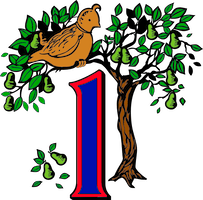
The 'partridge in a pear tree' means God. (In 'The Twelve Days of Christmas', it can also mean Jesus who died on the cross. In ancient times a partridge was often used as mythological symbol of a divine, sacred king. Partridges weren't introduced into England, from France, until the 1770s, which also points to any extra meanings being added later!)
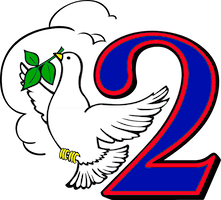
The 'two turtle doves' are the Old and New Testaments of the Bible.
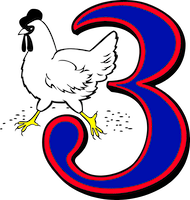
The 'three French hens' are the Christian Trinity: God the Father, His Son Jesus and the Holy Spirit. (The hens could also mean faith, hope and love - the three gifts of the Holy Spirit. [See 1 Corinthians 13]; or the Wise men who visited Jesus; or the three gifts they brought him!)
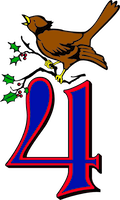
The 'four calling birds' (originally 'four collie birds' - an old name for Blackbirds!) are the four Gospels in the New Testament of the Bible. (They could also mean the four major Old Testament prophets [Isaiah, Jeremiah, Ezekiel, and Daniel]; or the four horsemen of the Apocalypse!)
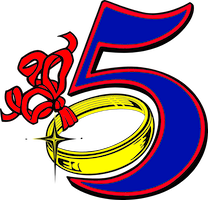
The 'five golden rings' are the five senses. (They could also mean first five books of the Bible also called the Pentateuch, the Books of Moses or the Torah.)
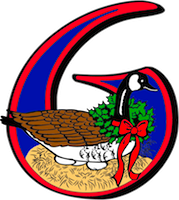
The 'six geese a-laying' are the six days of creation.
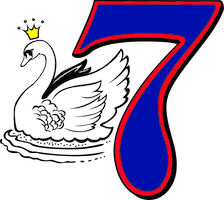
The 'seven swan a swimming' are the seven 'liberal arts' studied in medieval universities. (They could also mean the seven gifts of the Holy Spirit. [See 1 Corinthians 12:8-11, Romans 12, Ephesians 4, 1 Peter 4:10-11])
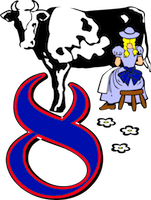
The 'eight maids a milking' are the eight beatitudes, Jesus' teachings on happiness. (See Matthew 5:3-10)
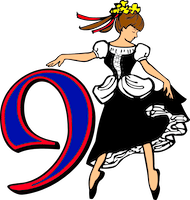
The 'nine ladies dancing' are the nine muses from Greek Mythology. (The ladies dancing could also mean fruits of the Holy Spirit. [See Galatians 5:22])
The 'ten lords a-leaping' are the Ten Commandments in the Bible. (See Exodus 20)
The 'eleven pipers piping' represent eleven thousand [meaning a lot of people] who had been martyred (killed) for the Christian faith. (The pipers piping could also mean the eleven faithful disciples of Jesus.)
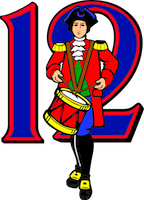
The 'twelve drummers drumming' were the twelve disciples of Jesus (They could also mean the twelve points of the Apostles' Creed!)
How many gifts are there in total in the 12 Days of Christmas?
If you were receive all the presents in the song, you'd get 364!
Day 1 - receive 1 gift
Day 2 - receives 3 additional gifts, making 4 total gifts
Day 3 - receives 6 additional gifts, making 10 total gifts
Day 4 - receives 10 additional gifts, making 20 total gifts
Day 5 - receives 15 additional gifts, making 35 total gifts
Day 6 - receives 21 additional gifts, making 56 total gifts
Day 7 - receives 28 additional gifts, making 84 total gifts
Day 8 - receives 36 additional gifts, making 120 total gifts
Day 9 - receives 45 additional gifts, making 165 total gifts
Day 10 - receives 55 additional gifts, making 220 total gifts
Day 11 - receives 66 additional gifts, making 286 total gifts
Day 12 - receives 78 additional gifts, making 364 total gifts received.










 Traditions of Christmas Bells